
Is your business missing out on millions by overlooking supply chain efficiency? What if unlocking massive value in M&A deals was easier than you think?
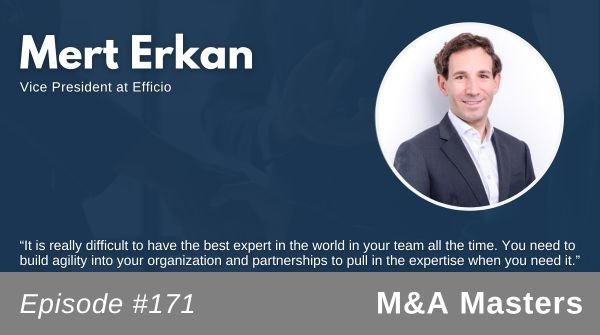
In this episode, Mert Erkan, Vice President of Efficio Consulting, joins Patrick Stroth to reveal how procurement and supply chain transformations drive game-changing results for both private equity and strategic acquirers on a global scale.
You’ll discover…
- The surprising percentage of EBITDA growth hiding in procurement synergies
- How “clean room” analysis can set post-merger integration up for instant success
- Why even high-tech companies are underinvesting in their supply chain teams—and what to do about it
- The Formula 1 approach to leveraging AI and digital tools in procurement
- What resilience and agility really mean for modern supply chain networks—and why it matters more than ever
Mentioned in this episode:
Transcript
Patrick Stroth: Hello there. I’m Patrick Stroth, trusted authority in executive and transactional liability and national practice leader for mergers and acquisitions for Liberty Company Insurance Brokers, where we provide peace of mind with great care. Welcome to M&A Masters, where I speak with the leading experts in mergers and acquisitions, and we’re all about one thing here.
That’s a clean exit for owners, founders, and their investors. Today, I’m joined by Mert Erkan, Vice President of Efficio Consulting. Mert plays a key role in executing Efficio’s international growth strategy, assisting private equity and other acquirers with large procurement transformation engagements. There’s a lot there to unpack, Mert. So great to have you. Welcome to the podcast.
Mert Erkan: Thanks, Patrick. Great to be here.
Patrick: Now, Mert, before we get into Efficio Consulting, in that entire world of major engagements that you guys are involved in, let’s start with you. How did you get to this point in your career?
Mert: I’m one of the partners at Efficio. Joined the firm 13 years ago. Today, I co-lead our private equity business out of New York. And prior to Efficio, I was with another consultancy. And before that, I started my career with an investment banking in their M&A team.
Patrick: So let’s talk about Efficio Consulting. Exactly what is type of consulting services? The scope is international. So give us that picture, please, Mert.
Mert: Of course. Efficio is the largest international procurement and supply chain consultancy. We are a specialist firm with 1500 people, 50 different nationalities, across 18 offices around the world. And in North America, 70% of our revenue is coming through private equity on clients. However, internationally, we have many large corporate or public sector client base as well.
We work across the sectors from technology, industrials, pharma, healthcare, financial services to the likes of infrastructure, utilities, consumer goods, retail, and many others. What we are known for is really being hands-on, working together with our clients side-by-side, delivering results and making them a lot faster, a lot more effective, helping them to build their competency in procurement supply chain.
Patrick: Talk about how large Efficio is. How many people are there? Where’s your reach? Is it global?
Mert: It is completely global. So we have coverage across North America, Europe, Asia, the Middle East, and we are, at the moment, 1500 people with 50 different nationalities, as I was mentioning.
Patrick: And so you’re on the macro side, the large side of M&A with massive strategic acquirers. And then you’ve got, and you’re leading the private equity practice. So let’s talk about this type of consulting in the scope of M&A, because I can just imagine that when we’re at scale, there are 1000s of parts and locations spread throughout the globe.
Somebody’s got to make sense of it. And you know, I’m sure it plays a real big role in a decision whether to acquire a target or not. So let’s talk about that. What do you do specifically with regard to mergers and acquisitions consulting situations?
Mert: Procurement and supply chain often represent 25 to 50% of the synergy potential, obviously, depending on the industry and specific acquisition case. The opportunities are really high for many industries, from healthcare, you know, manufacturing, to tech business, high-growth business. And you can drive your EBITDA by 25 to 35% through procurement and supply chain, basically.
And in addition to that, for a lot of businesses today, their growth is highly supported by their partners, suppliers. Therefore, there is a strategic focus for the businesses on procurement and supply chain. Same thing on risk management, securing supply. Exactly like you said, it is a highly strategic topic.
Patrick: Oh, I can imagine. I think early along, I learned what a lot of people don’t realize, that the significant expense is not personnel for a company. It is moving goods and services, and supplies from point A to point B through the entire manufacturing process. Which a lot of us who were not, you know, hands-on with manufacturing, just don’t realize all the different steps.
And as you said, that could have a massive impact. Talk about some of the areas where that could happen. Because I can imagine, you know, the objective is not only to expand markets or capabilities, but also the reach efficiencies for an acquirer. So talk about some of the decisions that are working into that, and how you can help with those priorities.
Mert: Absolutely. The way we help our clients in M&A, similar in carve outs, a lot of private equity investments is so first before the investment cycle. So in the M&A case, that could be a clean room where basically we look at both of the companies, or three companies, you know, supply base, right, their spend level, suppliers contracts, and develop a really detailed plan together with them by respecting the clean room rules, obviously.
Which enables companies, on day one, to start benefiting from these synergies, executing these synergies. And that brings a lot of momentum, a lot of you know, high spirits, to prove to the investors, to the board, to the management team. Look, the merger is working, right? So the speed to get to these synergy targets is always massively important.
Patrick: Execution. I think it’s execution.
Mert: Yeah, exactly the ability to execute these and through procurement and supply chain, you have that opportunity, you can get to some of these synergies. And we often exceed these synergies with speed, which brings a lot of momentum, as I mentioned. And the other way to look at this is basically a lot of companies, the procurement supply chain is still, unfortunately, the under-invested area.
So this is the majority of our work. We provide boots on the ground, executing these opportunities together with our clients. Maximizing these based on our expertise, benchmarks, best practices, some of our AI solutions to maximize benefits and get there faster. While we are doing that, and I think in every M&A case, you gotta keep a very close eye on how you’re building the required competency, required team in place so you can deliver these benefits, but also sustain these benefits and keep delivering year on value on top.
Patrick: I can imagine sometimes when you’re doing the research on a target, you identify inefficiencies or other issues that once you guys are brought in, you can add tremendous value and really amp up the value of the target so the buyer is actually getting it at a discount.
Mert: Absolutely. This is one of the reasons private equity actually has been quite effective for a long time. I would say now, making sure that procurement supply chain is very often on the management team’s agenda. It is prioritized. It requires the required C-level support, which is required for success always.
And then by leveraging, taking, pulling these levers, executing these benefits, it adds tremendous value to the valuation multipliers. As I was mentioning, if you’re able to lift your EBITDA by 20%, 30%, 35%, that is fundamentally going to support your investment case and an exit case.
Patrick: I can see where private equity may have because they have a different perspective when they’re making an acquisition, because it’s more an investment and they’re going to try to build a value and then exit. Whereas a strategic their job is, whatever their business is. Making widgets. I am simplistic here, but making widgets, and this is where we can make more widgets faster, whatever.
Private equity comes in and says, well, we’re going to find a more efficient way. And it’s that focus on efficiency that delivers higher returns. And I think, as you mentioned earlier, and we could talk about this with the supply chain, hasn’t had a lot of attention to it. Now, the new perspective is coming in, and with your help, they’re identifying those pain points and providing solutions.
Mert: Absolutely correct. I think what has been really interesting in the recent years, we have had clients going through inflation crisis. Their whole annual level of EBITDA is stolen through the inflation crisis by the inflation crisis. In the past, this type of crisis used to come maybe every five years. Every three years, you know you would optimize something, and you would feel comfortable that will remain stable the next three years.
Five years. These days, the volatility is definitely high, and it seems like it will continue. Being so, which is even having an impact on the M&A and carve outs or levels of activity, and to deal with that type of environment, with this type of tariffs or inflation crisis, you just need to be really prepared.
And what does that mean? In practical terms, you need to have the competency in place, and you need to be able to cope with ups and downs. And what we are seeing as an organization, for many companies, they have 50 plus different levels of areas they need to manage, right from direct expenditure, indirect expenditure, technology span categories, logistics, packaging, whatnot.
And it is really difficult to have the best expert in the world in your team all the time. So yes, you need to have a really good team, but also you need to build into the agility in your organization. Build some partnerships like, you know, with us, or similar firms to pull in. When you need the expertise, when you need the, you know, delivery power, engine power, to cope with these ups and downs in the market is fundamentally critical for businesses as of today.
Patrick: So that could be just a specialist that comes in. I’m just thinking as a pro golfer, would need a swing coach, not for every tournament, but every once in a while, if they’re anticipating some things are devolving. Bring that fresh set of eyes in, and then with what’s happening out in business today is dynamic. So having a partner like Efficio consulting that not only has the size, but the scope, and depth of capability out there. Bring them in. Quick turnaround, quick tweaks, and then back out again until you need them again, right?
Mert: Absolutely, you’re absolutely correct. That’s it.
Patrick: You mentioned two things in there. First of all, is dealing with people and technology. So let’s talk about the technology side. Because when we think about these large procurement engagements, we’re thinking about factories and operating systems, machines, robots and so forth. Talk about technology because that’s a huge stack that, you know, people take for granted.
Mert: So, there is a lot of change happening in the procurement technology world with AI. We are seeing some efficiency. So as a firm, we have 100-plus people in our digital team. We have been, you know, testing, building some of our own AI solutions. Very practical things like how you can, with true read, analyze 5000 contracts, or how can you do that with, you know, 1 million rows of data, invoicing data, to build a good baseline, good insights on a span category.
Or how you can enable AI on some supplier research, or some of the tender RFP package built. So there are definitely huge opportunities which can help individuals to get more productive. One very key aspect we keep doubling down is, well, you might have the best Formula One car in the world, you still probably need a driver.
I know, with AI, you may not need a driver one day, but what we see on the ground is you still need a good ambitious analytics with own capable team to take the most out of it. And you know, to increase your effectiveness as a team. You can increase the amount of number of tenders you’re running, maybe.
The number of negotiations you’re running. You can maybe be faster analyzing certain data or finding some benchmarks, running more negotiations at the back of it. So what I’m trying to get to is, I think by leveraging some of these tools and capabilities, which has been growing in the market, you can do more as a team, rather than thinking I can have a smaller procurement team as of today.
Procurement supply chain teams, as I was mentioning, is already, you know, historically, has been quite underinvested anyway. So I think this is an opportunity for us as a community to keep our growth journey continuing on that path forward. So it is very exciting. There are a lot of options emerging. But again, we got to keep it real.
We got to test things on specifics and grow things at the back of that is what we are doing as a team. And on the flip side of some of this traditional S to P, end-to-end, procurement, supply chain technology, I think we have not been seeing like a lot of change on that front, meaning the opportunities capabilities are there.
Some of the challenges, gaps are still there as well. And again, there are ways you can complement some of those gaps, some of those opportunities, with higher level of analytics, data competence in your team, but also with AI and some similar target solutions out there in the market.
Patrick: We’ll get into you defining the profile of your ideal client? Before I do that, though, I did want to ask because we’re talking about everything in the M&A realm. Is Efficio Consulting regularly engaged on just companies that are in operation and they’re either flat line or not hitting their marks, and they have you come to help diagnose?
Mert: Absolutely, yes. I mean, in many of our recent M&A cases, I’ll give a couple of examples there. So we have been working for a food manufacturer, for instance, for an insurance company, for a healthcare company. In all of these cases, M&A synergies, as I was mentioning at the beginning, were around 25 to 50% of the total synergy value, which is fundamental to that super critical form that M&A investment case.
So people call us in before the deal is closed for a clean room, and/or after the deal is closed to execute. To maximize these opportunities across supply chain, you know, third-party spend and workforce, so where we do it all. And the opportunity for a lot of firms, well, as we know, there are some, you know, growth challenges, top-line challenges for a lot of firms. So it is the time now where we are seeing from a lot of our clients, you got to keep optimizing your operations, supply base, to keep improving your margin.
Patrick: Well, let’s go into this. Why don’t you give me a profile of your ideal client. Who is Efficio Consulting looking to serve?
Mert: Yes. So before I answer that question, I’ll give you another interesting example. We have another recent retail client, their revenue is around 800 million, and they have been, traditionally, have been working a lot with China. And a lot of their competitors, last three years, five years, they have been building a lot more optionality with other countries where you can actually support your supply chain, manufacture your products, and bring it back home and sell them.
So now this company back to your good terrorist point. There is a lot of challenges in front of this company, while some other competitors have the optionality, have the resilience and agility already baked in into supply chain. While this company, you know, they need a lot of help to keep rebuilding that supply chain. That’s one example.
So the people who are trying to deliver some EBITDA and cash improvement through their supply chain, and third participant. People who are ensuring they have the resilience, supply security, managing all of that risk. They reach out. People who want to build with speed.
Construction companies or infrastructure projects or companies, as I was saying, they’re looking into new product development through their supply chain, procurement partnerships.
All these clients or firms, they reach out to us, to get our support. To your question specifically, Patrick, our clients are, you know, across the industries, we work a lot with industrials, tech companies, healthcare, pharma, financial services, utilities, infrastructure, consumer goods, retail and many other specialist industries or sub-sectors.
What I would say, things like the restaurant groups or health care tech, and so on. We have many technology clients, large technology clients, but also small technology clients, where their revenue might be 300, 400 and we still, you know, find consistently same level of opportunities to improve their EBITDA and cash position.
Patrick: And these are going to be, these can be pure domestic companies, not just companies that are doing international trade and so forth?
Mert: Absolutely.
Patrick: Is there a minimum headcount in terms of size employees?
Mert: I would say, I would say, no. There is no minimum headcount. I think the revenue level, spend levels I was referring to, we don’t have a specific. Because what is interesting on the number of employee side, it can be, you know, heavily outsourced business, or heavily in sourced business. Which can be, you know, misguiding us. But, yeah, we have many small to large clients, basically.
Patrick: You had mentioned earlier about how there’s volatility throughout the environment right now for business. And this is a tough ask, but can you tell us, what trends do you see going forward? We touched on tariffs. A lot of people have that top of mind. You’ve got the interest rates and other things top of mind. But from your perspective, with Efficio Consulting, what do you see going forward as we go into 2026?
Mert: So that’s a great question. Regardless of your human services, business people, business or a hardcore product business, I think one thing, what we see a lot of firms are really thinking twice about their network. Basically, this can be your workforce network around the world. This can be your good supply chain.
Where are you manufacturing? Where are you storing? How are you distributing network? And optimizing that network, building optionality, building some resilience, and doing some risk planning around it is key.
And to do these things well, as I was mentioning, the second trend really is the war for talent continues, so you really need to take it serious across all your directs, indirects, expenditures, supply chain, what type of team you need to build and really leverage these external partnerships you can build. Because when crisis happens, you need agility.
You may need some extra capacity, extra expertise, and if you are used as an organization working in that way, you have some strong partnerships that’s going to put you on the front foot. And because if you’re not used to it, well, then the crisis happens. It’s just too late to get yourself used to building some relationships and bringing these people on.
And obviously the biggest trend, as you all talk these days, is the AI, right? And AI, we talked a bit about that. I think we all need to educate ourselves. That’s the interesting fact, when we interact with people on the ground, you know, with a lot of our colleagues, clients, measures of the people we have not even just tested, trialed things.
How I can increase my own personal productivity? What type of, I think we all get very excited to talk about really large, visionary things, end-to-end, and what you know, the future can look like. That’s all great. But I think we gotta also start taking advantage step-by-step, by using some really practical tools, finding those and improving our own productivity as the functions.
And this can be from again, there are some very practical tools we build. Also some other partners we know out there built in terms of what the spend categories, are they going to go up or go down? So we used to do some in-depth research. Back in the day, it used to take us weeks time, months.
People didn’t have that type of time. These days a lot easier. It just takes hours, days. And same applies to some of the complex, the usual operational complexity we deal as procurement professionals, with some invoicing data, contracting data, dealing with large RFP volumes. That all gets a lot easier, easier with some tools, but also with the growing talent around the world.
Patrick: Yeah, your observation earlier on AI, I’m actually going to steal it, because you can build the fastest, most agile Formula One race car, but you need a driver. And that’s why you’re still going to need humans in this and say, is a wonderful, wonderful tool to get you from point A to point B a lot faster, but you’ve got to have somebody that’s going to get you there safely and get to the right destination, not the wrong destination.
So there’s a lot going on, but I think that there are a lot of dynamic elements out there. I think a lot of it is going upwards. There’s actually more abundance than scarcity that is happening. And Effiio Consulting is a firm that’s going to help a lot of companies get from point A to point B. So I mean, what a real pleasure. Mert Erkan from Efficio Consulting, how can our audience members find you?
Mert: You can reach me on LinkedIn. My name there is Mert Erkan, and my email address is mert.erkan@efficio.com. It is also on our website. If you just Google my name, that will come up.
Patrick: And for us Californians, Mert is spelled M E R T. Okay, and so Mert Erkan, it’s a real pleasure having you here on the show. Thanks again for a lot of your perspectives as we don’t get to see things on the macro level like this. So thanks again for being here.
Mert: Thanks a lot, Patrick. Have a great weekend.