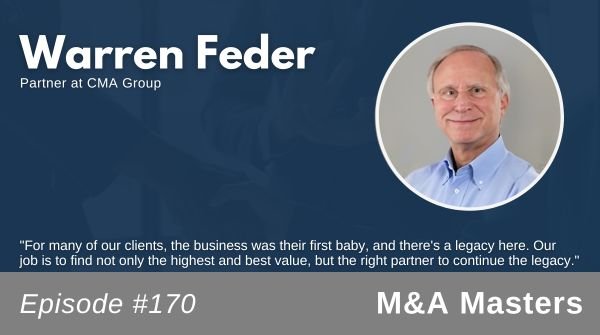

Navigating the emotional twists and turns of selling a family-owned business isn’t just about the highest offer—sometimes, it’s about finding the right partner to carry on your legacy. What does it really take to achieve a clean, meaningful exit?
In this episode, Warren Feder, Partner at CMA Group, joins Patrick Stroth to reveal how investment bankers guide owners and founders through complex transitions, ensuring both financial success and continuity for generations to come.
You’ll discover…
- The surprising reason one family business owner chose the lowest offer in a multi-bid sale
- How “complexity is our specialty” comes to life in deals with challenging family dynamics
- The evolving landscape of M&A for baby boomers—and why gray hair matters
- The crucial role of rep and warranty insurance in accelerating successful exits
- What’s really driving optimism for M&A in 2026, and how private equity is responding
Mentioned in this episode:
Transcript
Patrick Stroth: Hello there. I’m Patrick Stroth, trusted authority in executive and transactional liability and national practice leader for mergers and acquisitions, for Liberty Company Insurance Brokers, where we provide peace of mind with great care. Welcome to M&A Masters, where I speak with the leading experts in mergers and acquisitions, and we’re all about one thing here. That’s a clean exit for owners, founders, and their investors.
Today, I’m joined by Warren Feder, partner of the newly branded CMA Group, which was formerly known as Carl Marks Advisors. CMA Group is celebrating its 100th anniversary of providing investment banking services with an emphasis on family-owned or closely held businesses. Their motto is, complexity is our specialty. Warren, it is great to have you. We had the pleasure of meeting in person during my east coast swing a couple of weeks ago. Good to see you today.
Warren Feder: Thank you, Patrick. It’s an absolute pleasure to be here. It was a pleasure chatting with you in our office in New York, and it’s a delight to be joining you and your listeners.
Patrick: Well, let’s catch up the audience because they weren’t sitting in on your newly furnished office there in New York. Before we get into CMA Group, let’s start with you. What led you to this point in your career?
Warren: Well, I’ve had an eclectic career, Patrick. I started life off as a merger and acquisition attorney in New York and London, doing large, complex deals for corporations and investors. Then I joined my own family business, which was a manufacturer of hair brushes, hair ornaments, shampoo, and conditioner. And I spent 10 years working with my father and brother, growing a business together and dealing with all the bumps and all the challenges that come about by being in a family business.
And after that, I worked and founded another company, Gordon Brothers Capital, where we provided bridge capital to companies that had opportunities but needed someone who really understood what went on in companies to provide them the capital they needed to get to the next stage. Those three things led to my co-founding the investment banking group at the CMA Group, a little under 25 years ago.
Patrick: And the CMA Group, with the ironic original name, Carl Marks Advisors, which you know, when they think Carl Marks, CMA, Carl Marks actually opened up before the Karl with a K came along and got known for other things. But talk about the CMA group. You know, you’ve been around for 100 years. Why the rebrand and just the overall background in the organization?
Warren: Well, we are a fourth-generation family business, which gives us great insight and identification with many of the family businesses that we end up representing, and it’s often our privilege to represent. We have new leadership after many years, and the new leadership, together with the other partners, thought it was a great time to bring a fresh approach. And since we spend our time really with entrepreneurs and family businesses that have built up great businesses and are now looking for the next stage in the business’s evolution, we thought a rebranding made a ton of sense.
Patrick: Carl, CMA group, you’ve been focused on the lower middle market, family-owned businesses. Talk about that commitment to that section, because after 100 years, you would have figured you guys would have been going up market substantially since your founding.
Warren: For us, working with entrepreneurs and families is really a very special skill set that I think we understand better than most. I was in my own family business with my father and brother for 10 years. I used to say my brother is 3000 miles away, and it’s not quite far enough. So, reall,y the intricacies of partnerships in closely held businesses, coupled with family in many cases, really is where we earn our money and provide value for our clients. And as a fourth-generation family business, we really understand that at Carl Marks.
Patrick: The investment banking space has grown quite a bit. Probably as few as maybe 15 years ago, there were maybe 1000 investment banking firms out there, other advisory-type companies. That’s now ballooned to 5x. Tell me what CMA Group is bringing to the table that the other you know, burgeoning companies aren’t bringing? What sets you apart?
Warren: Well, first and foremost, we have an in-depth appreciation for the great accomplishment it is to actually have created a business and have it profitable, and support multiple families. When I was an M&A lawyer, we looked at numbers, we looked at documents. I had no appreciation of that.
After spending 10 years running a family business with my father and brother, this is hard to do. And if you’ve been able to do that and build a business and provide a service or a product in such a way that your customers are happy, your employees are happy, your partners are happy, and make money at the end of the day, that’s hard.
And it’s really our privilege to be able to work with a family or an entrepreneur who’s built something like this and help them get to the next stage, which is often a very large check for their business. But you know, truthfully, Patrick, it’s not always about the money.
Patrick: Which a lot of people don’t believe. What is it about?
Warren: Well, it’s certainly our job to make sure you get a full and fair and the highest price possible for the business that you’ve built. But for many of our clients, like it was with my father, the business was their first baby, and there’s a legacy here.
There are employees, there are suppliers, there are customers, there’s a reputation that, in many cases, goes back generations, and that’s equally important to our clients. So our job is to find not only the highest and best value, but the right partner to continue the legacy and the right structure to make sure everything comes together.
Patrick: You know, I’ve heard that echoed over and over again in a real competitive M&A community. It’s not always the highest dollar for your offer that wins. It’s oftentimes, you know, where the owner or founder, particularly if it’s an owner or founder, they want to see a fit for transition, even if they’re not going forward with the new company. And they’re, you know, heading off into the sunset.
They still want to see that legacy that they built, you know, sustain itself and go on, because it brought so much joy and so much benefit to a lot of people. And I think that’s one way where firms like yours can provide that extra little edge, because you’ve been entrepreneurs and founders yourselves. And so you’re speaking the same language. I would say you’ve got simpatico priorities with them. Wouldn’t you agree?
Warren: Absolutely. Let me tell you a little story. Last year, we closed on the sale of a 70-year-old business called Royal Products. The owner was second generation and 82 years old, and he built a great culture, and he had a management team of five key people who had been there on average, 25 years each.
And they owned some phantom equity in the business, and he owned the primary equity. And it was up to us to find the best partner, to not only pay full value to the 82-year-old owner and his partners, but to continue the legacy, which was very, very important to them. At the end of the day, we had four companies really interested in partnering with them and buying this business, and they were all, you know, reasonably close to each other.
And our client decided to choose the lowest of the four bids because they felt that the cultural affinity with the bidder and the fact that the bidder was going to allocate more equity to a larger employee base as they grow the business in the future was more important than that incremental small amount of dollars. And we also then jumped in to make sure that the management team, who would have been taxed at ordinary income, got very favorable structure and taxes so that they were able to get capital gains and no taxation for their rolled equity at close.
Patrick: And this is a great benefit, and the reason why I want to have this podcast and platform an organization like CMA Group, because there are so many owners and founders that are not used to doing these types of transactions, and the danger is they will, if they don’t know where to look, they’ll default and either look to be acquired by a competitor or a peer in their industry through strategic acquisition, or they’re going to default to some institution and talk to them.
Neither side really has its interests at heart. And you know, they may end up losing money or overpaying and getting, you know, services that were underprovided ,and they don’t know where to go. That’s why it’s wonderful to have organizations like CMA Group out there. And I mentioned before, there are 1000s of investment bankers and all these other things.
Everybody’s got a different fit. I sense. And when we had our conversation, you really connected with the baby boomers. Because I mean, you take their business personally. Talk about that a little bit. And you know why the baby boomers?
Not just because you’re part of that group too, but you know why that’s a fit? Because I just couldn’t see an owner or founder, as you mentioned, in their 60s, 70s meeting, I don’t want to put them down, but you know a 30-something-year-old investment banker who says, look, I know where you’re coming from. It doesn’t connect.
Warren: No, that’s very true. I mean, having some gray hair, or certainly less hair than I had when I was younger, has proven to be a real asset. It’s the personal touch, really. And we’re not a volume shop. Some of the larger investment banks, even the larger boutiques, they have to get a certain number of deals done, and they have pressure to close deals.
And if a deal isn’t going the right way, they then move on to some other deal. That’s never the case with us. If an owner and a family hires us to help them sell their company and take it to the next stage, this is a privilege. We’ve been selected in a as you mentioned, there are 1000s of bankers out there, and they’ve chosen us. And I take that very, very seriously, and I’m involved from the first time I meet them until we plan a spectacular closing dinner.
And every step of the way, I’m involved with any material decision. And this is where kind of the background I have as an M&A lawyer, and as an owner of of company and as an investor all comes in. Because I could look at 100 issues and say, these three issues are the important ones.
And these are the ones that can make or break the deal, and these are the ones that have value consideration. The other 97, the lawyers can figure out one way or the other, and truthfully, it’s not going to make that much of a difference. But these issues are the ones that we have to, you know, really care about.
Patrick: Those are the non-negotiables you’ll find those three, and it’s like, let’s focus on those, not waste energy and money on the other 97, which those are, give or take, and you’re not going to notice those. So, yeah, that’s interesting. Now, in addition, we referenced this with the baby boomers and the owner and founder, but give us a profile, Warren, of your ideal client. Who is CMA Group looking to serve?
Warren: I’ll give you two examples. During Covid, in the middle of Covid, we were working with a second-generation family business, where there were four siblings owned a school bus transportation business. And imagine Patrick trying to sell a school bus transportation business when Covid hit.
And all of a sudden there were no busses going anywhere. So we put a pause on everything. We went back when there was more stability about six months afterwards, and we closed a great sale. But here we were dealing with one of the four siblings was the CEO who was running the company and did a great job.
The other three were not involved with the business. So finding a way to get all four parties on board behind a transaction and get everything done, that’s something that we do pretty well, and we were able to do that very successfully with regard to this business.
Patrick: Well, you’re good at herding cats and finding alignment there. That’s a real talent.
Warren: Yeah, the hard part is really not dealing with the other side. The other side tends to be either a private equity firm who’s in the business of buying companies, and we know what their requirements are, and we could address that pretty straightforward. Or it’s a strategic buyer who’s in the industry, and we generally know how to deal with them.
The challenge, as you say, is herding cats and dealing with the personalities. Ultimately, it comes back to you took my toy truck when you were three years old, that I still resent you for, and now I’m not going to sign a $200 million deal. And that’s not too far off there. The other company we dealt with last year and closed successfully was called JDC Power, and they supply critical power systems to data centers.
And there they had three entrepreneurs who owned the company equally, and you couldn’t get a deal done unless all three agreed. Well, two of them were not talking to the third for the last year. So I think we did a lot of good in getting this deal done, but I get most credit from the lawyers and from the clients in getting all three parties to agree to a structure and a deal so that we were able to close the transaction.
Patrick: Industry wise, I’m sure there aren’t any school bus transportation verticals out there, so I would say, are you agnostic in terms of industry? And then how about geography?
Warren: Geography, we’re throughout the United States, and we’ve closed deals pretty much everywhere. We are generalists overall, but we’ve now been focusing on business services, consumer products, and industrial technology. And they’re fairly wide categories, but we’ve been very successful in those areas, and we’ve closed deals, you know, for clients in those areas, and those are areas that we bring some extra expertise.
Patrick: Okay, is there a minimum either EBITDA, financial size you deal with, or anywhere?
Warren: We generally like transactions that have an enterprise value between 30 and $300 million. So we’re under where the Morgan Stanleys and Goldman Sachs are, but we’re not doing early-stage venture capital deals or small shops either. We don’t do much in retail. We don’t do much in real estate, and not a ton in tech.
Patrick: Well, from a couple of the scenarios you just gave because I want to underline this and it’s in sync with your motto, okay, if there are owners, founders, sellers, with family dynamics or something that is complex, that’s something you specialize in. Because when you talk about complexity is our specialty, I think there’s nothing more complex than the human dynamic out there, particularly with family.
So I think that’s any family businesses, and again, across the country, over 30 million in enterprise value and up. I’m sure you’ll come down a couple couple mill if necessary. But you know, in that, I think that’s a great realm out there. One of the issues that has come up, one of the trends in mergers and acquisitions that’s really facilitated an acceleration in deals, is the development of reps and warranties insurance, because financial transactions have huge financial risks.
M&A transactions have huge financial risks, particularly to the seller, because this could be a lifetime or generational liquidity event. And you don’t want to get that wrong, which could, you know, force people to pause and freeze in these situations. And having a risk transfer vehicle like reps and warranties has really expedited processes and made things faster, cheaper, and happier in the transition-wise. But don’t take my word for it. Warran, good, bad, or indifferent. What’s been your experience with rep and warranty insurance?
Warren: I think when you go back 15 years, you really didn’t have rep and warranty insurance. A meaningful amount of the purchase price was held back in escrow for sometimes 12, 18, 24 months, and the negotiations of all the reps and warranties was a real slugfest between the buyer’s lawyer and the seller’s lawyer.
In the last seven or eight years, I can’t recall, Patrick, any deal that we’ve done that didn’t have rep and warranty insurance. And when we ask for letters of intent to help us choose the buyer that we want to work with and the partner to take the business forward, we make it a requirement that rep and warranty insurance is an integral part of the transaction. First and foremost, it minimizes risk for our client, which is very important and critical.
And second, they get to keep more money at close, which is, needless to say, extraordinarily important. And third, it actually makes the negotiation of the documents between the buyer and the seller’s lawyer much simpler, because they know what is accepted, generally accepted market in the rapid warranty world, and they all gravitate to that. So you’re not fighting so much over allocation of risk, because the risk is going to be borne primarily by the insurance carrier.
Patrick: One of the newest developments, if you’ve been aware of rep and warranty for years, is it has been used in now 95% of middle market M&A deals, these are transactions above $75 million in enterprise value. And I can’t think of one deal at that level that doesn’t carry it. However, you know, a lot of smaller deals in the 10 to $40 million range may not necessarily be a fit for traditional buy-side rep and warranty.
That’s why there’s a new product out there. It is called TLPE, transaction liability, private enterprise. It is a re-engineered form of rep and warranty designed specifically for smaller, less complex, less risky transactions, again, as low as a million dollars in enterprise value, up to, can be as high as 50 million in enterprise value, and the cost, there’s no underwriting fee, which are huge savings.
And the cost is a fraction of the cost of rep warranty, because they are smaller deals. They deserve a smaller rate because it’s a lot less risk. Again, TLPE, transactional liability, private enterprise. Now, Warren, as we’re you know, moving in, looking forward to the first half of 2026, what do you see going forward for mergers and acquisitions, either broadly or specifically with regard to CMA?
Warren: Well, thank you, Patrick. Two weeks ago, I was at a conference where we had speed dating with 40 different private equity firms. Think of it every 20 minutes, you know someone else shows up at your table, and you catch up on what the PE firm is investing in and what might be in the transactions and companies that we’re that we’re working with. And uniformly, everyone said the first half of 2025 was very slow. Slowest it’s been in memory.
And the prior two months had more activity than all of the first half of the year. So we are optimistic that that is going to continue into 2026. I think what the overhang was earlier in the year had to do with tariffs, and also had to do, which we’ve seen in now a couple of deals with immigration workforce.
So here you have situations where some food service companies, landscaping, and other manual labor companies really rely on an immigration workforce. And with some of the ICE crackdowns and what’s going on, it just adds uncertainty to transactions, and an institutional investor is not going to invest in a company unless everything is buttoned up.
So I think people are getting more comfortable with the tariff situation. I also think that interest rates are coming down a bit, so that the cost of debt is less prohibitive than it was earlier in the year. And the private equity firms have $3 trillion that they have to spend at some point, and the longer they wait, the more negative impact it has on their return to their investors.
Patrick: I have fallen for the instant gratification that I was hoping for. I just look back at 2024 and thinking that there was a slowdown in activity, because the big uncertainty was the election. And once the election was decided, I thought we would be off to the races in 2025. And sometimes you can’t turn that ship around on a dime. It takes a little bit longer.
And, as with you, I think there are a lot more business-friendly positive forces that it takes some time for them to get ingrained and for people to get immersed in. And I think that they’re going to start moving forward as well. I’m an optimist at heart, and as you and I are looking at owner, founder companies, many baby boomers, who, despite anything else that’s happening in the world, one thing that’s not stopping is the clock.
And they’re all aging, and so they’re looking for a transition. So I think the next year or two should be robust, and with organizations like CMA out there helping these owners and founders not only find that exit, but find the right exit. That’s why it was all worth it. And so, you know, I think it was important. It was just a real pleasure to meet you, Warren, and to share the story of CMA with our audience here. Tell us, how can our members find you?
Warren: Well, my email is wfeder@theCMAgroup.com. Our website is theCMAgroup.com, and I am on LinkedIn as well. And so I welcome any inquiries from any of your listeners. Part of the joy I have in the work I do is meeting entrepreneurs and helping them get the benefits of what they’ve often worked on for their entire life, or sometimes generations. And it’s a privilege, and truthfully, it’s been a lot of fun for me.
Patrick: I’ll tell you, Warren, as people who are owners and founders that they’re selling, you’re only going to do this once. You spent all this time; you may as well do it right. And I think you would be well served by reaching out to CMA. Warren Feder, from CMA, absolute pleasure having you. Thanks for joining us today.
Warren: Thank you, Patrick.