
Are millions of dollars in business value quietly disappearing as Baby Boomer owners retire with no succession plan? What if there was a private equity model built specifically to preserve their legacy—while unlocking the growth they never got around to chasing?
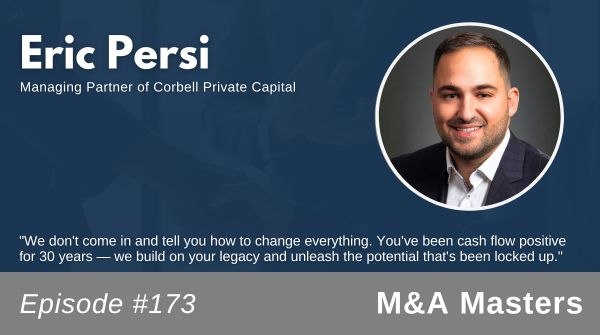
In this episode, Eric Persi, Managing Partner of Corbell Private Capital, joins Patrick Stroth to share how his Canada-based firm is acquiring and growing lower middle market businesses across North America—honoring what owners built while unleashing the potential they left on the table.
You’ll discover…
- Why the “silver tsunami” of retiring owners is creating a once-in-a-generation acquisition opportunity
- How Corbell acquires majority stakes (75–80%) and partners with sellers to carry their business—and their legacy—forward
- The real difference between financial engineering and value creation—and why Corbell bets on the latter
- What a landline phone as a “sales team” taught Eric about the low-hanging fruit hiding in lower middle market businesses
- How Corbell targets $2–10M EBITDA companies in commercial construction, industrial services, and fabrication
- The honest take on rep and warranty insurance—including what Corbell found frustrating—and the new Lloyd’s of London product making smaller deals more accessible
- What’s coming in M&A for the rest of 2026: more competition, smarter sellers, and why Corbell is doubling down
Mentioned in this episode:
Transcript
Patrick Stroth: Hello there. I’m Patrick Stroth, trusted authority in executive and transactional liability and national practice leader for mergers and acquisitions for Liberty Company Insurance Brokers, where we provide peace of mind with great care. Welcome to M&A Masters, where I speak with leading experts in mergers and acquisitions, and we’re all about one thing here—that’s a clean exit for owners, founders, and their investors. Today, I’m joined by Eric Persi, Managing Partner of Corbell Private Capital. Corbell Private Capital is an investment company based in Canada that is centered on capitalizing on the unique opportunities created by the wave of retiring business owners and founders across Canada and the United States. It’s a sad story to see great entrepreneurs come to the end of their line with nowhere to go—far too many just lock the doors, turn off the lights, and move on. So it’s great to have Eric and Corbell Private Capital here to talk about an answer to that, so these businesses can have their legacy move forward. Eric, it’s great to have you. Welcome to the podcast.
Eric Persi: Thank you very much for having me, Patrick.
Patrick Stroth: Before we get into Corbell Private Capital, let’s talk about you. What brought you to this point in your career?
Eric Persi: I’ve always been entrepreneurial, having started numerous businesses and projects over the past 20 years, so landing here felt inevitable. Those endeavors covered everything from landscape services to wine importation to technology plays and private equity. Some were born out of wanting to be my own boss. Some happened by accident—like the wine importation business. I picked up wine as a hobby, got my certified sommelier designation, and the natural entrepreneur in me said, “I should do something with this.” So I started importing wines into Ontario. But what really got me into private equity was my time at Links Equity Limited—a private equity firm focused on a buy-and-hold strategy, 100% buyout of small and medium-sized businesses in the lower middle market. It was a great place to let my entrepreneurial spirit thrive. I spent just over eight years there, did almost 20 deals, worked across a lot of different industries, and got to work with a lot of great sellers—entrepreneurs who had built something and were looking for the right place to put it. Now at Corbell, our model is a little different. We acquire majority stakes, typically around 75 to 80%, and we form a partnership with the seller and their management team to carry the business forward. We’ll eventually exit our position at some point in the future, though that’s not a predefined timeline.
Patrick Stroth: For context—when you say lower middle market, what enterprise value range are we talking about for Corbell?
Eric Persi: For Corbell, enterprise values range anywhere from $10 to $60 million. Our largest deal so far was upwards of $60 million, and our smallest was around $11 to $11.5 million. For platform acquisitions, we’ll go up to that $60-plus range. For bolt-on strategic acquisitions, we’ll certainly look below the $10–12 million mark.
Patrick Stroth: You didn’t name it Persi Private Capital—so how did you come up with “Corbell”?
Eric Persi: No pride of ownership for me there. We really look at ourselves as a team—I’ve always known this would depend on a lot of people beyond just myself. Corbell is short for Corbelino, the small town in Italy where my grandfather was from. He came to Canada after World War Two with very little—whatever he could carry and whatever was in his pockets—and he built a great career and a great life. But it was how he did it that was inspiring to me: through a relentless dedication to building relationships, being collaborative, and never burning bridges. That’s how I like to conduct business, and it’s how our team does too. We’re all aligned in our values and our mission. So it felt right to pay homage to him and where he came from—given everything he sacrificed so that his kids and grandkids could have the life they wanted. When we see our logo—the little mountain, which is one of the largest mountains in Italy—we think about where we came from and what’s possible through hard work, determination, and doing business the right way.
Patrick Stroth: I think that story also makes Corbell accessible to the lower middle market. A lot of owners think they’re too small for private equity, or that PE firms are only interested in glitzy, high-flying deals. What you’re describing—starting from little and building through relationships—is the story of most of these owners too. So what does Corbell actually bring to the table for them?
Eric Persi: We provide a future for the business. And we can relate to these owners—many of them didn’t even know there was a market for their business until a year or two before speaking with us. It’s always a rewarding moment when we get to tell someone, “We’re going to pay $30 million for your business.” A lot of these owners started in the field with a small crew 20, 30, even 40 years ago—never imagining they’d arrive at that moment. Many started out of necessity: they got laid off, or the person they worked for retired and just locked the doors. So when we come in, we give a lot of respect to what they’ve built. We don’t come in and say, “You’ve been doing this for 30 years and been cash flow positive the whole time—now we’re going to tell you how to do things.” We build on their legacy. We provide a future for their business and their people. But at the same time, these are businesses with a lot of locked-up potential. Some haven’t changed certain elements in years, if not decades. So we work on the business while they work in the business. We’re thinking about how to make things more efficient, find cost savings through procurement strategies, outsource strained functions, generate leads. We like to be very good partners—without being disruptive.
Patrick Stroth: You mentioned optimization—giving a fresh set of eyes without reworking everything. Can you share some real examples of that?
Eric Persi: I’d say it’s more “more with the same” than “more with less.” We try to keep as much intact as possible. One real example: at a couple of our companies, the estimating team was a bottleneck. They could only process so many jobs in a day. We started outsourcing the initial takeoff work—going through the plans, identifying scope—to external providers, so the current team could focus on doing more estimates as we pursued bigger jobs and new geographies. From a procurement standpoint, we’ve leveraged our industry contacts to drive cost savings across projects—not cutting staff, just using our resources to improve margin and win more work. We’ve also introduced labor management and production staff strategies that these companies weren’t using before. And one of the biggest gaps we find: almost none of these companies have a formal business development or sales function. I had an owner once who, when I asked who the sales team was, pointed to his landline and said, “When that thing rings, I pick it up.” All inbound. If people don’t know you’re a leader in your space, that message needs to get out there. We’re not going to tell a drywall company how to mud a seam—that’s their expertise. We just say, “Have you tried this? Can we introduce you to this person?” That’s what we do.
Patrick Stroth: And I think it’s worth addressing the misconception that private equity is purely about financial engineering—cut staff, squeeze margins, and pressure whoever’s left. Talk about how Corbell approaches the investment case.
Eric Persi: To be transparent: when we underwrite our deals, we do it very conservatively—basically assuming we won’t unlock all the additional value. We underwrite as if the only return driver is paying down the acquisition debt. Where all the gain comes for us and our investors is in unlocking what we actually go find. We even tell our sellers this upfront: there are very favorable returns on the other side of this if we can grow the top line by 10% and improve EBITDA margin by 10%. They know exactly how we get our returns—and it only comes by improving the business. For us, that just means the team gets to do their jobs a bit more efficiently and productively. It’s a win-win-win.
Patrick Stroth: And most sellers are also rolling equity, so they get a second bite when that value grows. Give me the profile of your ideal target—a bit more specific than 11 to 60 million.
Eric Persi: We serve two categories: the sellers whose businesses we acquire, and the investors. On the acquisition side, we look for businesses doing $2 to $10 million of EBITDA in either Canada or the US. That typically comes from $10 to $100 million in revenue—well-established businesses with some management depth. Beyond the numbers, we look for low customer concentration, low supplier concentration, robust teams, and industries we know well: commercial construction, industrial services, fabrication. On the investor side, we’re looking for people who understand the opportunity in stable, cash-flowing businesses and have the patience to let the value unlock. Because we acquire at modest multiples—not 10x revenue—the return potential if we can pick some of that low-hanging fruit is really exceptional. And there’s meaningful downside protection given how cash flow positive these businesses are. So we serve two very different clients: the retiring owner who wants a good home for their business, and the patient investor attracted to stable, cash-flowing assets.
Patrick Stroth: Let’s talk about rep and warranty insurance. I use an analogy: the difference between the Porsche at the dealership and the one on the racetrack isn’t the engine—it’s the brakes. Better brakes let you go faster and safer. Rep and warranty does the same for M&A. Good, bad, or indifferent—what’s been your experience?Eric Persi: I’m a car guy, so I appreciate that analogy. We used rep and warranty on one deal at Corbell, and I do see the value—especially when there’s a little more complexity on the legal